Sunday, December 14, 2008

--CVN-78 ~ 2013--

The Gerald R. Ford-class aircraft carriers (or Ford-class) will be the next generation supercarrier for the United States Navy. Before its redesignation as the Ford-class (CVN-78), this new class of carriers was known as the CVNX carrier program ("X" meaning "in development") and then as the CVN-21 carrier program. (Here, the "21" is not a hull number; it is common in "future" plans in the U.S. military, as an allusion to 21st century, to distinguish from existing 20th century equipment.)
~
The first hull of the CVN-21 line will be
Gerald R. FordTemplate:WP Ships USS instances. The CVN-21 uses the basic hull design of the preceding Nimitz-class.
~
~
~http://en.wikipedia.org/wiki/Supercarrier
~
~http://en.wikipedia.org/wiki/Gerald_R._Ford_class_aircraft_carrier

--HMS Ark Royal 1938--

The first ship to be described by the New York Times as a supercarrier was HMS Ark Royal in 1938; with a length of 685ft and a displacement of 22,000 tons, she was designed to carry 72 aircraft. In 1943 the superlative was transferred to the 45,000-ton carriers of the Midway class, as a step-up from the 27,000-ton Essex class. The post-war standard for supercarriers was set by the proposed USS United States and USS Forrestal.
~
HMS Ark Royal (
pennant number 91) was an aircraft carrier of the Royal Navy that served in the Second World War. She was torpedoed on 13 November 1941 by the German submarine U-81 and sank the following day.
~
Designed in 1934 to fit the restrictions of the
Washington Naval Treaty, Ark Royal was built by Cammell Laird and Company, Ltd. at Birkenhead, England.
~
Completed in November 1938, she served in some of the most active naval theatres of the Second World War, and was involved in the first aerial and U-boat kills of the war, operations off Norway, the search for the German battleship Bismarck, and the Malta Convoys. Ark Royal survived several near misses and gained a reputation as a 'lucky ship'. The Germans incorrectly reported her as sunk on multiple occasions.
~
Her design differed differed from previous aircraft carriers. Ark Royal was the first ship on which the hangars and flight deck were an integral part of the hull, instead of an add-on or part of the superstructure. Designed to carry a large number of aircraft, she had two hangar deck levels. She served during a period that first saw the extensive use of naval air power; a number of carrier tactics were developed and refined aboard Ark Royal.
~
Her sinking was the subject of several inquiries; investigators keen to know how the carrier was lost, given there were efforts to save the ship and tow her to the naval base at
Gibraltar. They found several design flaws contributed to the loss, which were rectified in new British carriers. Although recorded as sinking 22 nautical miles (41 km) from Gibraltar, Ark Royal was located in December 2002, approximately 30 nautical miles (56 km) from Gibraltar.
~
~
~http://en.wikipedia.org/wiki/Supercarrier
~
~http://en.wikipedia.org/wiki/HMS_Ark_Royal_(91)

Saturday, December 13, 2008

--B-52 Stratofortress-Tribute - 53 years of Air Power--


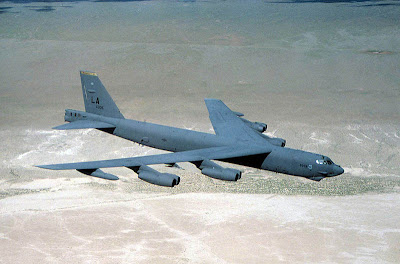
B-52 Stratofortress

The Boeing B-52 Stratofortress is a long-range, subsonic, jet-powered, strategic bomber operated by the United States Air Force (USAF) since 1955.

Beginning with the successful contract bid on 5 June 1946, the B-52 went through several design steps; from a straight wing aircraft powered by
six
turboprop engines to the final prototype YB-52, with eight turbojet engines. The aircraft made its first flight on 15 April 1952 with "Tex" Johnston as pilot.

Built to carry nuclear weapons for
Cold War-era deterrence missions, the B-52 Stratofortress replaced the Convair B-36. Although a veteran of a number of wars, the Stratofortress has dropped only conventional munitions in actual combat. With the longest unrefueled range of any contemporary bomber, the B-52 carries up to 70,000 pounds (32,000 kg) of weapons.

The USAF has had B-52s in active service since 1955, initially with the
Strategic Air Command (SAC), with all aircraft later absorbed into the Air Combat Command (ACC) following SAC's disestablishment in 1992. Superior performance at high subsonic speeds and relatively low operating costs have kept the B-52 in service despite proposals to replace it with the Mach 3 XB-70 Valkyrie, supersonic B-1B Lancer and stealthy B-2 Spirit.

In January 2005, the B-52 became the second aircraft, after the
English Electric Canberra, to mark 50 years of continuous service with its original primary operator. There are five aircraft altogether that have made this list; the other three being the Tupolev Tu-95, the C-130 Hercules and the KC-135 Stratotanker.
~
~http://en.wikipedia.org/wiki/B-52

Friday, December 12, 2008

--$500 million note--


HARARE, Zimbabwe (CNN) -- Zimbabwe's central bank is introducing a $500 million note -- the highest current denomination -- as the once-prosperous southern African nation battles against spiraling hyperinflation.
~
Finance Minister Samuel Mumbengegwi made the announcement about the new note in a government gazette set for release Friday. On the back, the purple cotton bill will feature pictures of dairy cows being milked mechanically and a miner drilling underground, he said.

The Reserve Bank of Zimbabwe (RBZ) last week introduced a new set of denominations, including a $100 million note, but that has not helped to clear long lines for cash at banks. Some people sleep outside banks after failing to get cash.

The RBZ said a $200 million note would be in circulation Friday, together with the $500 million note.
~
~

Wednesday, December 10, 2008

--Universal Declaration of Human Rights--


The Universal Declaration of Human Rights (UDHR) is a declaration adopted by the United Nations General Assembly (10 December 1948 at Palais de Chaillot, Paris). The Guinness Book of Records describes the UDHR as the "Most Translated Document" in the world.
~
The Declaration arose directly from the experience of the Second World War and represents the first global expression of rights to which all human beings are inherently entitled. It consists of 30 articles which have been elaborated in subsequent international treaties, regional human rights instruments, national constitutions and laws.
~
The International Bill of Human Rights consists of the Universal Declaration of Human Rights, the International Covenant on Economic, Social and Cultural Rights, and the International Covenant on Civil and Political Rights and its two Optional Protocols. In 1966 the General Assembly adopted the two detailed Covenants, which complete the International Bill of Human Rights; and in 1976, after the Covenants had been ratified by a sufficient number of individual nations, the Bill took on the force of international law.
~
~
~
~http://en.wikipedia.org/wiki/Universal_Declaration_of_Human_Rights

Thursday, December 4, 2008

--Kiss Off Stress--

Did you know that the holiday season is the time of the year when you're most likely to die from a heart attack? According to research at the University of California, the deadliest day is Christmas, when you're 5 percent more likely to have a cardiac event. Of course, all the key stressors (finance, family, travel) seem destined to be worse this year (they always do). Since a restful night's sleep or an hour at the gym isn't always possible, here are 10 quick ways to stress less.
~
One second: Swear
Researchers at England's University of East Anglia Norwich looked into leadership styles and found that using swear words can reduce stress and boost camaraderie among coworkers. Good luck, #!$*&^*@!

~
Five seconds: Pop fish oil
According to research from the University of Pittsburgh, people with the highest blood levels of EPA and DHA omega-3 fatty acids are happier, less impulsive, and more agreeable. Try a daily supplement of
400 milligrams each of EPA and DHA fish oils.

~
10 seconds: Eat dark chocolate
A study published in Proceedings of the National Academy of Sciences showed that the flavonoids in cocoa relax your body's blood vessels. Look for low-fat dark chocolate, which has more stress-busting flavonoids than milk chocolate.
~

30 seconds: Know your hoku
Acupressure is a quick tension releaser, according to researchers at Hong Kong Polytechnic University who found it can reduce stress by up to 39 percent. For fast relief, massage your hoku (the fleshy part between the thumb and index finger) for 20 to 30 seconds. "This is the universal pressure point for easing upper-body tension," says Patrice Winter, a spokeswoman for the American Physical Therapy Association.

~
30 seconds: Sit back
Forget what you've been told about sitting up straight to relieve tension in your back. Researchers at the University of Alberta Hospital in Canada found that leaning back at a 135-degree angle is the best sitting position for alleviating back pain.

~
One minute: Add garlic
Researchers at the University of Alabama at Birmingham believe they've figured out why garlic is good for heart health, and their finding implies it's a powerful stress buster too. When you digest garlic's main ingredient, organosulfur allicin, your body produces hydrogen sulfide, which relaxes blood vessels and increases blood flow.

~
Three minutes: Brew tea
In a study at University College in London, 75 men were given tea before completing two stressful tasks. Afterward, their cortisol levels dropped an average of 47 percent, compared with 27 percent for men who weren't given tea.

~
Five minutes: Take a YouTube timeout
Just the anticipation of laughing decreases the stress hormones dopac, cortisol, and epinephrine by 38, 39, and 70 percent, respectively, according to researchers at Loma Linda University in California. And when researchers at the University of Maryland showed short movie clips to study participants, those who watched funny films experienced a 22 percent increase in blood flow to their hearts.

~
Eight minutes: Budget wisely
"Money is the biggest source of stress for a man during the holidays," says Bonnie Eaker Weil, Ph.D., author of Financial Infidelity. And with good reason: Men who avoid making budgets spend an average of 36 percent more on holiday gifts than those who don't, according to a 2002 survey. So go easy on your wallet and your heart. Sit down with your wife and quickly calculate how much you two want to spend on gifts this year.

~
10 minutes: Just do it
Kissing or hugging your wife can reduce stress because it raises levels of oxytocin, the hormone associated with bonding and love, say researchers at the University of North Carolina. And a Scottish researcher found that having sex regularly lowers anxiety, stress, and blood pressure.

~
~
~http://health.msn.com/health-topics/articlepage.aspx?cp-documentid=100228142&GT1=31036

--WAR LORDS--Joseph Stalin--


Joseph Vissarionovich Stalin (real surname Dzhugashvili) (Georgian: იოსებ სტალინი, ნამდვილი გვარი ჯუღაშვილი, Russian: Иосиф Виссарионович Сталин, ISO 9: Iosif Vissarionovich Stalin; December 18 [O.S. December 6] 1878 – March 5, 1953) was General Secretary of the Communist Party of the Soviet Union's Central Committee from 1922 until his death in 1953. He gradually consolidated power and became party leader and dictator of the Soviet Union, establishing the regime now known as Stalinism.
~
Following the death of
Vladimir Lenin in 1924, Stalin prevailed in a power struggle over Leon Trotsky, who was expelled from the Communist Party and deported from the Soviet Union. Stalin launched a command economy in the Soviet Union replacing the New Economic Policy of the 1920s with Five-Year Plans in 1928 and at roughly the same time, forced rapid industrialization of the largely rural country and collective farming by confiscating the lands of farmers.
~
He derogatorily referred to farmers who refused his reforms as "kulaks", a class of rich peasant which had in actuality been wiped out by World War I; millions were killed, exiled to Siberia, or died of starvation after their land, homes, meager possessions, and ability to earn an existence from the land were taken to fulfill Stalin's vision of massive "factory farms". While the Soviet Union transformed from an agrarian economy to a major industrial powerhouse in a short span of time, millions of people died from hardships and famine that occurred as a result of the severe economic upheaval and party policies.
~
At the end of 1930s, Stalin launched the Great Purge, a major campaign of political repression. During his continued repressions, millions of people who were a threat to the Soviet politics or suspected of being such a threat were executed or exiled to Gulag labor camps in remote areas of Siberia or Central Asia, where many more died of disease, malnutrition and exposure. A number of ethnic groups in Russia were forcibly resettled for political reasons. Stalin's rule, reinforced by a cult of personality, fought real and alleged opponents mainly through the security apparatus, such as the NKVD. In the 1950s, Nikita Khrushchev, Stalin's eventual successor, denounced Stalin's rule and the cult of personality, thus initiating the process of "de-Stalinization".
~
Bearing the brunt of the Nazis' attacks, the Soviet Union under Stalin made the largest and most decisive contribution to the defeat of Nazi Germany during World War II (1939–1945), despite Stalin's policy mistakes before and during the war. These included a devastating internal policy which weakened the Soviet society and strategic blunders during the first period of Great Patriotic War. Additionally the Molotov-Ribbentrop pact, and its secret protocol, cleared the way for Hitler's invasion of Poland in 1939 and the beginning of the war itself.
~
Under Stalin's leadership, after the war, the Soviet Union went on to achieve recognition as one of just two superpowers in the world. That status lasted for nearly four decades after his death until the dissolution of the Soviet Union. Stalin's rule had long-lasting effects on the features that characterized the Soviet state from the era of his rule to its collapse in 1991.
~