
Showing posts with label RELIGIONS. Show all posts
Showing posts with label RELIGIONS. Show all posts
Saturday, May 5, 2012


Thursday, February 17, 2011
--元宵節-Chap Goh Meh 2011--

 Chap Goh Meh or Tzap Goh Mei (Chinese: 十五暝; pinyin: shí wǔ míng; literally "fifteen night") represents the fifteenth and final day of the Lunar New Year period as celebrated by Chinese migrant communities. The term is from the Hokkien dialect and refers to the fifteenth day of the first month, which is the occasion of the first full moon of the New Year.
The occasion is marked by feasting and various festivities, including the consumption of tangyuan and Kue Keranjang. In traditional Chinese culture, it is also celebrated as the Lantern Festival or the Shang Yuan Festival. In Southeast Asia, however, it coincides with the Chinese Valentine's Day. It is also when young unmarried women gather to toss tangerines into the sea, in a hope that their future spouse will pick it up – a custom that originated in Penang, Malaysia. In the past, this was also the only day that unmarried ladies could be seen with their partners.
~
元宵節,亦稱為上元節、小正月、元夕、小年或燈節,日本稱上元(じょうげん)、小正月(こしょうがつ),朝鮮稱正月大滿月(정월대만월)、正月大보름(정월대보름,「보름」為固有詞,月圓、望日之意,或簡稱大보름)、上元(상원)、元宵(원소)、元夕(원석)、烏忌日(오기일),時間是每年的農曆正月十五。
元宵節是新年的第一個月圓之夜,象徵著春天的到來,人們吃元宵、賞燈、猜燈謎,以示祝賀。這是春節之後的第一個重要節日。中華明朝錢塘瞿佑《雙頭牡丹燈記》:「每歲元夕,於明州張燈五夜。傾城士女,皆得縱觀」。在這一天,人們要吃元宵,鬧燈會,猜燈謎,提燈籠,許多地方還有拉兔子燈,放天燈的習俗。是華人社會的盛大節日之一。
~
~http://en.wikipedia.org/wiki/Chap_Goh_Meh~
~http://zh.wikipedia.org/zh-tw/元宵節
~
~http://www.nst.com.my/nst/articles/4chap/Article/
~
~http://en.wikipedia.org/wiki/Lantern_Festival
~
~
Friday, February 11, 2011
--红鸡蛋--


Thursday, February 10, 2011
--拜天公 2011--

 福建人拜天公,除了感恩外,也祈求天公在新的一年,赐福给全家人,让合家大小平安,步步高升。 大年初九凌晨,成千上万的烧猪和鸡、鸭,将是祭拜天公的主要祭品,以祈求新春大吉大利。天公诞的祭拜仪式,是从大年初八深夜开始,一直持续到初九凌晨。 烧猪,是孝敬天公的重点祭品之一,一些经济不错的家庭,甚至订购大烧猪供 拜,而普通的家庭也以小金猪或烧肉祭拜,以祈求天公带来好运。 所以,拜天公这一天,烧猪的销量非常可观。当天祭拜天公的大小烧猪,超过数万只之多。 而早在大年初八,烧猪店推出的大、小烧猪,非常抢手,销量也可观,大家都赶早买烧猪及其它祭拜用品,为夜晚的祭拜天公作好准备。
据乌美2道焱全烧腊中心老板卓照发说,今天大年初八,包括他已接到1000只烧猪的订单,估计可卖出超过1500只大小烧猪,销量不比去年差。往往在大年 初八,就像除夕一样,一清早巴刹就闹哄哄一片,不少人纷纷拥到巴刹购买鸡、鸭、大鱼、大肉和水果,扛着一棵棵的甘蔗回家。 忙碌烹煮一番后,深夜时辰一到,就摆好丰富祭品,安好天公座,点起香烛祭拜天公。祭拜天公的祭品,包括鸡鸭、鱼虾、甘蔗、水果、香烛、大金、小金、香烛、 龙香等等。 拜天公时,必须诚心膜拜,一点不能马虎,早年还要燃烧爆竹,彻夜响个不停,一直拜到大年初九凌晨时分,才圆满结束,这时全家人一起享用丰富年餐,才上床睡 觉。据卓照发说,从订单来看,今年的小金猪最抢手,大金猪销量也不错,他估计年初八从早到晚,会有更多人到店里买大小烧猪,门市估计可卖出数百只大小烧 猪。 卓照发说,农历新年的两个烧猪大旺日,是大年除夕与大年初八。除夕是祭拜神明、祖先的日子。大年初九拜天公,都少不了烧猪。到了大年十五的元宵节,烧猪的 销量也很可观。
拜天公源自明朝。
~
~http://www.hudong.com/wiki/天公
~
~http://www.praytothecreator.org/cn/cn_praying.html
~
~http://baike.baidu.com/view/340720.htm
Wednesday, February 2, 2011
--团圆饭~Reunion Dinner--
 团圆饭(family reunion dinner) 。中国的春节,“吃”往往会成为大部分人节日期间的主要活动,一家人围坐在热气腾腾的饭桌旁,就是透着那么一股喜庆热闹劲儿,这可以算是中国民间过年的最大特点了。“民以食为天”这句话似乎在春节这个传统佳节更加显得入情入理。
~
~http://baike.baidu.com/view/776810.htm
~
~http://en.wikipedia.org/wiki/Reunion_Dinner
~
~http://en.wikipedia.org/wiki/Chinese_New_Year
Tuesday, February 1, 2011
--The Year Of Rabbit 2011--
 Why not have a look below to get a free forecast of what 2011, the Year of the Rabbit, holds for you! You’ll also find out what personal traits you need to let shine through the coming year!
~
The history of the Chinese Zodiac is very interesting! It is said that Buddha invited all of the animals in the world to join him for the New Year celebrations, but only 12 animals bothered to turn up. As a great reward, Buddha named a year after each one of them and they actually run in the order that the animals arrived to celebrate with Buddha, starting with the rat and ending with the last guest, the pig.
The Chinese believe that those born during a year of a particular animal would inherit some of the good and bad personality traits of that animal.
Also, each Chinese year is influenced by whatever animal it falls in. The Year of The Rabbit begins on February 3rd 2011. Most Rabbit years are quiet, positive and inspiring and 2011 looks to be heading in this direction – a refreshing change after the fast-moving and quite dramatic Year of the Tiger. Family, diplomacy and personal development will all be highlighted in 2011. Once again alternative sources of energy and green living will be under the spotlight. The arts and culture sector of society will very busy producing amazing works of art and staging important exhibitions throughout the year. Love, romance and family life are well-starred, with a renewed appreciation of loved ones and friends. Overall, it should be a fun and relatively peaceful year. Even though aggression, violence and war zones will still be in evidence, the Chinese Rabbit year favours peaceful solutions and diplomacy, so there will be a feeling that all is not lost and that hope is still very much alive.
Let’s take a look at each animal, their major personality traits and what the prospects are for 2011, the Year of the Rabbit.
~
~http://www.moonslipper.com/chinese.html--"The journey of a thousand miles begins with one step - Lao Tzu"--
 Laozi (Chinese: 老子; pinyin: Lǎozǐ; Wade–Giles: Lao Tzu; also Lao Tse, Lao Tu, Lao-Tzu, Lao-Tsu, Laotze, Laosi, Lao Zi, Laocius, and other variations) was a mystic philosopher of ancient China, and best known as the author of the Tao Te Ching. His association with the Tao Te Ching has led him to be traditionally considered the founder of Taoism (also spelled "Daoism"). He is also revered as a deity in most religious forms of the Taoist religion, which often refers to Laozi as Taishang Laojun, or "One of the Three Pure Ones". Laozi translated literally from Chinese means "old master" or "old one", and is generally considered honorific.
~
According to Chinese tradition, Laozi lived in the 6th century BC. Historians variously contend that Laozi is a synthesis of multiple historical figures, that he is a mythical figure, or that he actually lived in the 4th century BC, concurrent with the Hundred Schools of Thought and Warring States Period.
~
A central figure in Chinese culture, both nobility and common people claim Laozi in their lineage. Throughout history, Laozi's work has been embraced by various anti-authoritarian movements.
~
The five colours blind the eye.
The five tones deafen the ear.
The five flavours dull the taste.
Racing and hunting madden the mind.
Precious things lead one astray.
Therefore the sage is guided by what he feels and not by what he sees.
He lets go of that and chooses this.
~
Look, it cannot be seen - it is beyond form.Listen, it cannot be heard - it is beyond sound.
Grasp, it cannot be held - it is intangible.
These three are indefinable, they are one.
~
From above it is not bright;
From below it is not dark:
Unbroken thread beyond description.
It returns to nothingness.
Form of the formless,
Image of the imageless,
It is called indefinable and beyond imagination.
~
Stand before it - there is no beginning.
Follow it and there is no end.
Stay with the Tao, Move with the present.
Knowing the ancient beginning is the essence of Tao.
~
~
~http://en.wikipedia.org/wiki/Laozi
~
~http://www.moonslipper.com/chinese.html
~
~http://www.answers.com/topic/lao-zi
~
~http://www.chebucto.ns.ca/Philosophy/Taichi/lao.html
~
~
Sunday, January 30, 2011
--Nian~~年獸--


 In Chinese mythology, a Nian (simplified Chinese: 年兽; traditional Chinese: 年獸; pinyin: nián shòu) is a beast that lives under the sea or in the mountains. Once each spring, on or around Chinese New Year, it comes out of hiding to attack people, especially children. The Nian is sensitive to loud noises and is afraid of the color red. The Chinese Lion Dance is known to have originated from the legend of the Nian. The tradition began when a Nian attacked a village. After the attack, the villagers discussed how to make the Nian leave them alone. Eventually they came up with a plan where drums, plates and empty bowls were hit, red robes were worn, and firecrackers were thrown, causing loud banging sounds that would scare off the Nian. This scared the Nian, and since that time, the Nian has not appeared in the village again. The Nian is still believed to exist, but that it is scattered about the jungle and mountains, never to appear in front of a human again.
~
年獸是一種傳說生物。相傳在遠古時代,有一種頭如獅子身如壯牛的兇惡怪獸叫「年」,一年四季都在深海裡,但逢新舊歲之交,便出來糟蹋莊稼,傷害人畜,百姓叫苦連天。有一次它又跑到村莊裡為非作歹,被一家門口晾的大紅衣服嚇跑了。到了另一處,又被燈光嚇得抱頭鼠竄。於是人們掌握了「年」怕聲音、怕紅色、怕火光的弱點。每至年末歲首,人們就在家門口貼紅聯、放鞭炮、掛紅燈,院子里燒柴禾、攏旺火,用菜刀剁菜肉,發出聲音,把「年」嚇得逃回海裡,不再危害人們。人們得以安全。
~
據說被鴻鈞老祖收服,成為其坐騎。
~
~http://en.wikipedia.org/wiki/Nian
~
~http://www.monstropedia.org/index.php?title=Nian
~
~http://zh.wikipedia.org/zh-tw/年獸
Tuesday, January 25, 2011
Sunday, December 26, 2010
--Boxing Day 2010--

Boxing Day is a bank or public holiday that occurs on 26 December, or 27 December, and is observed in Australia, Austria, Canada, New Zealand, the United Kingdom, and in some Commonwealth nations that have a mainly Christian population. In South Africa, the public holiday 26 December is called Day of Goodwill, in Ireland St Stephen's Day or Lá an Dreoilín, and in continental European countries the "Second Christmas Day."
Though not an official holiday in the United States, some Americans use the term "Boxing Day," particularly those who live near the Canada – United States border. In Canada, Boxing Day is listed in the Canada Labour Code as an optional holiday. Only the province of Ontario has made it a statutory holiday where all workers receive time off with pay.
~
Friday, December 24, 2010
Wednesday, December 22, 2010
--冬至 2010--


Friday, October 8, 2010
--九皇大帝圣诞千秋 2010--


 Legend of the Nine Emperor Gods
The Nine Emperor Gods (called “Jiu Wang Ye 九王爷” in Singapore and Malaysia) actually refer to the “Jiu Huang Da Di 九皇大帝” (The Nine Great Emperors) in the Taoist deities system (Taoist Patheon).
The birth of the Nine Emperors happened to be on the 9th of September in the Chinese Lunar Calendar, and this day was often celebrated as the festival of “Jiu Huang 九皇” by the Taoist in Singapore and Malaysia.
The Nine Emperor Gods are very often known as “Bei Dou Jiu Xing 北斗九星” (9 North Star Plough Gods), since they are Gods of the stars or planets. Their mother, “Dou Mu Yuan Jun 斗母元君” (Mother North Star), is also the Mother of Stars.
The Nine Emperor Gods consist of the following:
1. “Gou Chen Tian Huang Da Di 勾陈天皇大帝” (Vega Star)
2. “Bei Ji Zhi Wei Da Di 北极紫微大帝” (Polaris Star)
3. The 7 Northern Constellation Stars (called “Bei Dou Qi Xing 北斗七星”):a. “Tan Lang 贪狼”
b. “Ju Meng 巨门”
c. “Lu Chun 禄存”
d. “Wen Qu 文曲”
e. “Lian Zhen 廉贞”
f. “Wu Qu 武曲”
g. “Po Jun 破军”
Nine Emperor Gods Festival
8th - 16th October, 2010
9th moon 1st to 9th day
(Chinese Lunar Calendar)
九皇大帝圣诞千秋
2010年10月8日到16日
九月初一到初九
~
~
~http://www.nine-emperorgods.org/legend/
~
~http://yuukihome.spaces.live.com/blog/cns!7E2EB93DA8A6DC4E!919.entry?wa=wsignin1.0&sa=899669513
Thursday, September 16, 2010
--Malaysia Day Sep. 16th--
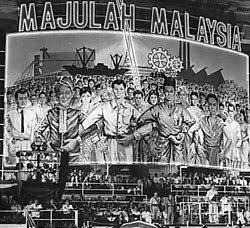
Malaysia Day is held on September 16 every year to commemorate the establishment of the Malaysian federation on the same date in 1963. It marked the joining together of Malaya, North Borneo, Sarawak, and Singapore to form Malaysia. The formation of the new federation was planned to occur on June 1, 1963, but was later postponed to August 31, 1963, in order to coincide with the sixth Hari Merdeka. Several issues related to the Indonesian and the Filipino objection to the formation of Malaysia delayed the declaration to September 16 of the same year. The postponement was also done to allow the United Nations team time to conduct referendums in North Borneo (now Sabah) and Sarawak regarding the two states participation in a new federation. The formation of Malaysia was made possible through the introduction of the Malaysia Bill to the Malayan Parliament on July 9, 1963, and consent from the Yang di-Pertuan Agong on August 29, 1963. Prior to the formation of Malaysia, Singapore and North Borneo unilaterally declared independence from the United Kingdom on August 31, 1963, thus coinciding with the sixth anniversary of the Malayan independence. Beginning year 2010, September 16 is a federal public holiday. It coincides with the birthday of the Yang di-Pertua of Sabah.
~
~http://en.wikipedia.org/wiki/Malaysia_Day
Saturday, September 11, 2010
--Sep. 11th 2001 9years of pain....--

The September 11 attacks (often referred to as September 11th or 9/11) were a series of coordinated suicide attacks by al-Qaeda upon the United States on September 11, 2001. On that morning, 19 al-Qaeda terrorists hijacked four commercial passenger jet airliners. The hijackers intentionally crashed two of the airliners into the Twin Towers of the World Trade Center in New York City, killing everyone on board and many others working in the buildings. Both buildings collapsed within two hours, destroying nearby buildings and damaging others. The hijackers crashed a third airliner into the Pentagon in Arlington, Virginia, just outside Washington, D.C. The fourth plane crashed into a field near Shanksville in rural Pennsylvania after some of its passengers and flight crew attempted to retake control of the plane, which the hijackers had redirected toward Washington, D.C. There were no survivors from any of the flights.
Nearly 3000 victims and the 19 hijackers died in the attacks. According to the New York State Health Department, 836 responders have died as of June 2009. Among the 2752 victims who died in the attacks on the World Trade Center were 343 firefighters and 60 police officers from New York City and the Port Authority. 184 people were killed in the attacks on the Pentagon. The overwhelming majority of casualties were civilians, including nationals of over 70 countries. In addition, there was at least one secondary death – one person was ruled by a medical examiner to have died from lung disease due to exposure to dust from the World Trade Center's collapse.
The United States responded to the attacks by launching the War on Terror: it invaded Afghanistan to depose the Taliban, who had harbored al-Qaeda terrorists. The United States also enacted the USA PATRIOT Act. Many other countries also strengthened their anti-terrorism legislation and expanded law enforcement powers. Some American stock exchanges stayed closed for the rest of the week following the attack and posted enormous losses upon reopening, especially in the airline and insurance industries. The destruction of billions of dollars' worth of office space caused serious damage to the economy of Lower Manhattan.
The damage to the Pentagon was cleared and repaired within a year, and the Pentagon Memorial was built adjacent to the building. The rebuilding process has started on the World Trade Center site. In 2006, a new office tower was completed on the site of 7 World Trade Center. The new 1 World Trade Center is currently under construction at the site and, at 1,776 ft (541 m) upon completion in 2013, it will become one of the tallest buildings in North America. Three more towers were originally expected to be built between 2007 and 2012 on the site. Ground was broken for the Flight 93 National Memorial on November 8, 2009, and the first phase of construction is expected to be ready for the 10th anniversary of the attacks on September 11, 2011.
~
~http://en.wikipedia.org/wiki/September_11_attacks~
~http://airtravel.about.com/od/shoppinggiftgiving/tp/sep11movies.htm
~
~http://september11news.com/
~
~http://www.youtube.com/watch?v=EFiEgwLQVJk
Friday, September 10, 2010
--Eid ul-Fitr 2010--
 Eid ul-Fitr (Arabic: عيد الفطر ‘Īdu l-Fiṭr), often abbreviated to Eid, is a Muslim holiday that marks the end of Ramadan, the Islamic holy month of fasting (sawm). Eid is an Arabic word meaning "festivity", while Fiṭr means "break-fasting"; and so the holiday symbolizes the celebration of break-fasting after completing the fasting of the entire month of Ramadan (calendar month). The first day of Eid, therefore, is the first day of the month Shawwal that comes after Ramadan.
~
Eid-ul-Fitr Salat (Namaz in Urdu/Persian) is a Wajib (strongly recommended, just short of obligatory) or mandoob depending on which juristic opinion is followed salat of two raka'ah (units) which is generally offered in an open field called Eidgah. This salat should be performed with Jama’at with extra six Takbirs, three of them in the beginning of the first raka'ah and three of them just before ruku' in the second raka'ah. Eid ul-Fitr is sometimes also known as the "Smaller Eid" (Arabic: العيد الصغير al-‘īdu ṣ-ṣaghīr) as compared to the Eid al-Adha that lasts four days following the Hajj and is casually referred to as the "Greater Eid" (Arabic: العيد الكبير al-‘īdu l-kabīr).
~
Muslims are commanded by the Qur'an to complete their fast on the last day of Ramadan and then recite the Takbir all throughout the period of Eid.
~
~http://en.wikipedia.org/wiki/Hari_Raya_AidilfitriFriday, May 28, 2010
--WESAK 2010--


Vesākha (Pali; Sanskrit: Vaiśākha वैशाख) is an annual holiday observed traditionally by Buddhists in the Indian subcontinent and South East Asian countries of Singapore, Vietnam, Thailand, Cambodia, Malaysia, Myanmar, and Indonesia. Sometimes informally called "Buddha's Birthday," it actually encompasses the birth, enlightenment (nirvāɳa), and passing away (Parinirvāna) of Gautama Buddha.
~
The exact date of Vesākha varies according to the various lunar calendars used in different traditions. In Theravada countries following the Buddhist calendar, it falls on the full moon Uposatha day (typically the 5th or 6th lunar month). Vesākha Day in China is on the eighth of the fourth month in the Chinese lunar calendar. The date varies from year to year in the Western Gregorian calendar but falls in April or May.
In 2010 the first full moon day in May is the twenty-seventh. However, Myanmar and Cambodia observe the event this year on April 28, 2010.
~
~http://en.wikipedia.org/wiki/Vesak
~
~
Sunday, February 28, 2010
--十五暝 (Chap Goh Meh) 2010--


Chap Goh Meh or Tzap Goh Mei (Chinese: 十五暝; pinyin: shí wǔ míng; literally "fifteen night") represents the fifteenth and final day of the Lunar New Year period as celebrated by Chinese migrant communities. The term is from the Hokkien dialect and refers to the fifteenth day of the first month, which is the occasion of the first full moon of the New Year.
The occasion is marked by feasting and various festivities, including the consumption of tangyuan. In traditional Chinese culture, it is also celebrated as the Lantern Festival or the Shang Yuan Festival. In Southeast Asia, however, it coincides with the Chinese Valentine's Day. It is also when young unmarried women gather to toss tangerines into the sea, in a hope that their future spouse will pick it up – a custom that originated in Penang, Malaysia. In the past, this was also the only day that unmarried ladies could be seen with their partners.
~
~http://en.wikipedia.org/wiki/Chap_Goh_Meh
~http://en.wikipedia.org/wiki/Chap_Goh_Mei
Subscribe to:
Posts (Atom)
